
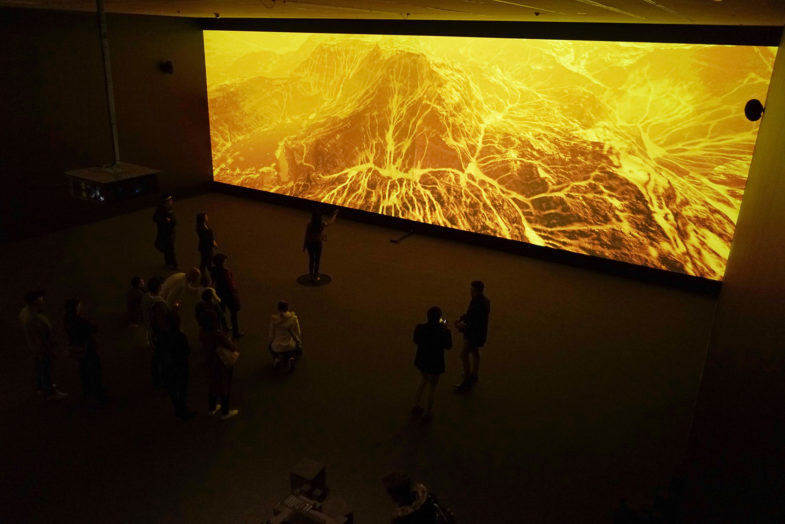
Geology 2015 Installation view, Energies: Haines & Hinterding, Museum of Contemporary Art Australia, Sydney, 2015. Real-time 3d environment, 2 x HD projections, game engine, motion sensor, spatial 3d audio. Commissioned by the Museum of Contemporary Art Sydney, with early support from Christchurch Art Gallery Te Puna O Waiwhitū, Christchurch, New Zealand. Museum of Contemporary Art Australia, purchased with funds provided by the MCA Foundation, 2016
Geology is an interactive work designed for projection and monitor display. It has been made with (circa 2015) game development technology using open-source tools provided by Epic Games, a company based in the USA. UE4.7.6 is the version of the software we used for Geology. It is a virtual world that investigates “how culture interacts with chaotic natural forces”. It was inspired by a site visit that we made to Christchurch Art Gallery Te Puna o Waiwhetū after it was damaged by the 2010/11 earthquake and aftershocks, and combines field recordings and other collected data with ideas drawn from science fiction, art and architecture.
Projected up to 16 m wide in the gallery, Geology creates a cinematic experience out of a computer-simulated environment and has three different levels that visitors can explore. Each is set in an imagined location which we think of as “speculative geography” where “the imaginary is placed on the same footing as the source material that comes from day-to-day reality”.
The first level is a vast mountainous landscape that the audience experiences by ‘flying’ over. While it resembles the Southern Alps / Kā Tiritiri o te Moana of New Zealand, with its icy peaks and scree slopes, this luminous yellow world has been generated mathematically. Floating above the rocky terrain are clusters of gleaming black cubes, which, if bumped into, provide the trigger for the visitor to be teleported to another dimension. The second level is a dark labyrinth with glinting crystalline walls which we think of as “an optical reverse anechoic chamber where electromagnetic energy might be captured and instead of dampened or transduced is amplified by simulated mirrors”. Rocks from the outside have found their way into this interior space but are no longer subject to gravity. Instead, they are trapped in this electromagnetic prison, gently moving around and humming with residual energy. The third level is an art gallery containing a sound work and two towering minimalist sculptures, each made from a precariously balanced stack of white square beams. A visitor’s movement within this space causes the towers to gently scatter and fall, creating the melancholy spectacle of a slow-motion collapse.
A person can move through Geology by standing in front of the projected image and shifting the position of their body. Their view of the landscape also shifts in relation to their movements – dropping them down low into the terrain, flying them through it, or teleporting them to another level. Haines and Hinterding worked with a motion sensor and the Unreal Engine 4, a computer-game development platform, to create this interactivity where a person can make minimal gestures in real space to create amplified movement and reverberating effects in the virtual world. Geology allows us to explore these strange transfers of energy, as we navigate landscapes of the imagination using only the dynamism of our bodies.
https://www.mca.com.au/collection/artworks/2016.2/
https://www.mca.com.au/exhibitions/energies-haines-hinterding/


Geology 2016 : Résonances Magnétiques – Haines & Hinterding, La Panacée, Centre D’Art Contemporaine Montpellier, France curated by Franck Bauchard.
Geology is an open-world, sandbox-type experience.This means that the focus of the user (the person who takes control of the camera, by making gestures in front of the Kinect motion sensor) is able to explore a large virtual world created by the artists. The user can travel by controlling a camera which has six degrees of freedom. The camera is sensitive to certain invisible and visible triggers or teleporters that enable magical leaps within the world. The work also has a collision detection system built into it, which stops the user from going through walls or invisible, preordained barriers within the environment. Many of the objects in the world of Geology have collision detection set to react under Newtonian rules when the camera impacts them. The artists have changed the forces of gravity in the world to allow massive objects to undergo the effects of collision, creating the feeling that the objects don’t respond to gravity in the usual way. Many classes of objects collide with the environment they are within, and act under novel values.
The user travels in the first-person perspective as if they are flying. The journey initially begins in an extensive algorithmically generated treeless landscape of some 8 x8 square kms filled with floating black (monad) boxes that collide with each other and some of which are portals into interior spaces. When the user collides with one of these portals they are transported (virtually) to another level. The notion of a level in this virtual space is a pure abstraction, since the world of the work and all of its components sit within a unified coordinate space of 10,000 unreal X units, 10,000 unreal Y units and 10,000 unreal z units. Therefore, relatively speaking, it is useful to describe various levels within the world as defined by particular atmospheres.
There are three distinct spaces within Geology. The yellow treeless mountainous terrain, the interior anechoic, techno militaristic, sci-fi interior, an optical machinic labyrinth filled with floating electromagnetic rocks. Finally, there is also a windowless and seemingly doorless room that contains a white gridded structure that perhaps has the geometrical echo of classic works of minimalist sculpture.
Within these different parts of the world there are many invisible portals that enable navigation from one space to another. If the work was left running a user could explore all the spaces in seemingly infinite combinations.
https://lapanacee.org/fr/exposition/resonances-magnetiques


.
Energies: Haines & Hinterding, (MCA survey exhibition tour) Christchurch Art Gallery, Te Puna O Waiwhetu, New Zealand
https://christchurchartgallery.org.nz/exhibitions/haines-hinterding-energies